

Funnel Builder vs Website Builder: What’s the Difference?
When starting an online business, many people encounter two types of tools: funnel builders and website builders. At first glance, they may seem similar because both help you create web pages. However, they serve different purposes and are designed for different goals.
Understanding the difference between these tools can help you choose the right platform for your marketing strategy and business growth.
What Is a Funnel Builder?
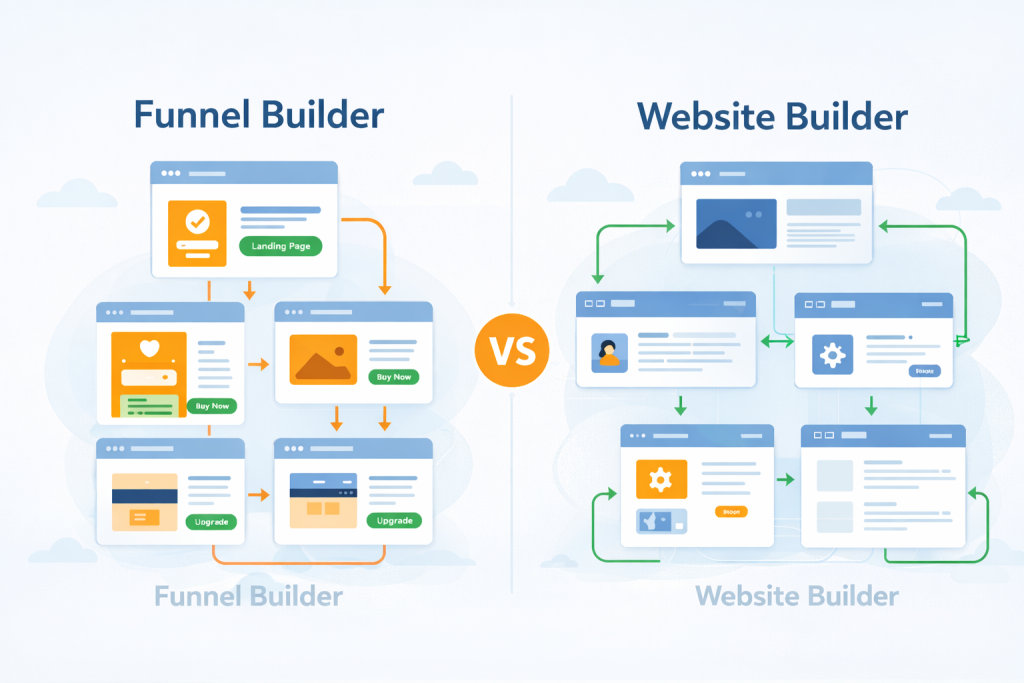
A funnel builder is a tool designed to guide visitors through a structured path that leads to a specific action, such as signing up for a service or purchasing a product. Instead of creating a traditional website with many pages and navigation links, funnel builders focus on conversion-driven page sequences.
A typical funnel might include:
- Landing page – introduces an offer or collects email leads
- Thank-you page – confirms the action and guides the visitor further
- Sales page – presents a product or service
- Checkout page – processes the purchase
- Upsell page – offers additional products or upgrades
These steps help move visitors through the buying process without distractions.
Many modern marketing platforms, such as Systeme.io and ClickFunnels, provide funnel-building tools that allow users to create complete marketing funnels without coding.
What Is a Website Builder?
A website builder is designed to create traditional websites that contain multiple pages and navigation menus. These websites usually provide information about a business, brand, or organization.
Website builders are commonly used to build:
- company websites
- blogs
- portfolios
- online stores
- informational websites
Instead of guiding visitors through a fixed path, website builders allow users to navigate freely between pages using menus and links.
Popular website building platforms include WordPress and Wix. These tools make it easy to design websites with customizable layouts and themes.
Funnel Builder vs Website Builder Key Differences
Although both tools create web pages, they differ significantly in their purpose and functionality.
| Feature | Funnel Builder | Website Builder |
|---|---|---|
| Primary goal | Convert visitors into customers | Provide information and content |
| Page structure | Sequential funnel flow | Multiple independent pages |
| Navigation | Limited navigation to reduce distractions | Full menus and navigation links |
| Marketing focus | Sales and lead generation | Branding and content publishing |
| Automation features | Often includes email automation | Usually requires separate tools |
Funnel builders prioritize conversion optimization, while website builders focus on content structure and browsing.
When Should You Use a Funnel Builder?
A funnel builder is ideal when your main goal is to guide visitors toward a specific action. It is particularly useful for:
- selling digital products
- generating leads through landing pages
- running marketing campaigns
- promoting online courses
- managing automated sales processes
Because funnels limit distractions and guide users step by step, they often produce higher conversion rates.
When Should You Use a Website Builder?
Website builders are better suited for businesses that need a complete online presence rather than a single marketing campaign.
They are commonly used for:
- business websites
- blogs and content publishing
- portfolio sites
- informational resources
- brand websites
A website builder allows visitors to explore different sections of your site and learn about your services or content.
Which One Is Better for Beginners?
The answer depends on your goal. If you want to create a blog or company website with many pages, a website builder is a good option. However, if your main focus is marketing, selling products, or collecting leads, a funnel builder may be more effective.
Many entrepreneurs today prefer all-in-one platforms like Systeme.io because they combine funnel building, landing pages, email marketing, and digital product management in a single platform.
If you want to learn more about how such platforms work in practice, you can also explore our detailed Systeme.io review, where we explain its features, pricing, and benefits for beginners.
Conclusion
Both funnel builders and website builders play important roles in online business. A funnel builder focuses on guiding visitors toward conversions, while a website builder focuses on creating a complete online presence with multiple pages and navigation options.
Choosing the right tool depends on your goals. If you want to increase sales and capture leads through marketing campaigns, a funnel builder may be the better choice. If you want to publish content and build a traditional website, a website builder will likely be more suitable.
Understanding how these tools work will help you build a more effective online strategy and choose the platform that best fits your business needs.